
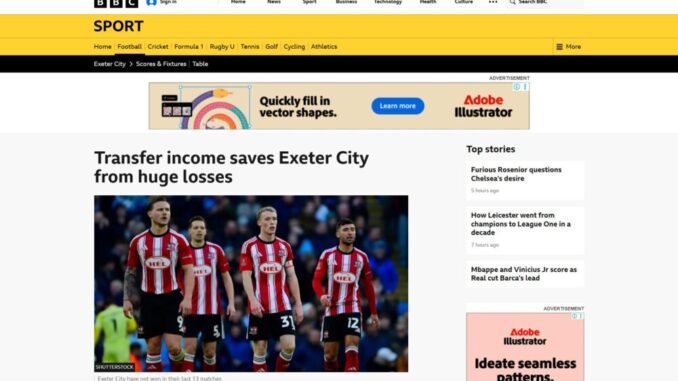
Exeter City Supporters’ Trust loan: In the landscape of modern English football, where billionaire owners and state-backed investments are increasingly common, Exeter City Football Club stands as a beacon of sustainable, fan-owned success. Central to this unique model is the Exeter City Supporters’ Trust loan, a financial mechanism that has evolved from a vital lifeline in the club’s darkest hours to a tool for long-term governance and growth.
The Origins: A Lifeline in 2003
The history of the Exeter City Supporters’ Trust loan is inextricably linked to the survival of the club itself. In 2003, Exeter City faced liquidation after being relegated from the Football League and burdened with approximately £4.5 million in debt by previous owners.
The Supporters’ Trust, formed in 2000, stepped in to purchase the club for a symbolic £20,000. To keep the club afloat during its transition into fan ownership, the Trust provided a long-term, interest-free loan funded by donations and fundraising from the loyal fanbase. This initial Supporters’ Trust loan was the bedrock upon which the club’s “debt-free era” was eventually built.
Evolution of the Exeter City Supporters’ Trust loan Model
Over the years, the nature of the financial support has shifted to adapt to league regulations and the club’s changing needs:
-
Loan vs. Donation: In 2012, the Trust transitioned some of its financial support from loans to direct donations. This strategic move helped the club comply with League Two “Salary Cost Management Protocol” (SCMP) rules, which limited player wage spending to 55% of turnover.
-
Emergency Facilities: Beyond long-term support, the Trust often acts as a safety net. For instance, as recently as April 2026, the Trust provided an additional £200,000 loan facility to help the club navigate mounting short-term financial pressures.
-
Repayment and Reinvestment: A landmark moment occurred on February 10, 2021, when the club officially repaid its long-term financial loan to the Trust in full. A total of £830,058 was returned to the Trust’s coffers.
Strategic Impact: Why the Exeter City Supporters’ Trust loan Matters
The Exeter City Supporters’ Trust loan is not merely an accounting entry; it is a fundamental part of the club’s governance.
1. Sustainable Governance
Repaying the loan allowed both the club and Trust boards to make more “sensible, strategic choices” for the next phase of ownership. It ensured that while the club remained competitive, it was never again at risk of the reckless overspending that nearly destroyed it in 2003.
2. Infrastructure and Academy Support
While the day-to-day running of the club is funded by revenue, the Trust uses its funds—including repaid loan capital—for specific projects. This includes capital expenditure to enhance the supporter experience and ongoing investment in the club’s renowned academy, which has produced stars like Ollie Watkins and Ethan Ampadu.
3. Protecting Working Capital
Even after loan repayments, the Trust ensures the club retains access to necessary working capital. This financial “cushion” allows the club to maintain a competitive team on the pitch while remaining a thriving, community-focused organization.
Conclusion on Exeter City Supporters’ Trust loan: A Blueprint for Fan Ownership
The Supporters’ Trust loan serves as a practical example of how football sustainability can work. By utilizing supporter-funded loans to bridge gaps and donations to satisfy league rules, Exeter City has transformed from a club on the brink of closure into a model for others to follow. Today, the loan system remains a vital safeguard, ensuring that “the Grecians” are always run by the supporters, for the supporters.
Be the first to comment